Mount Zion Baptist Church

Mount Zion Baptist Church

ARLINGTON, Va. — Founded in 1866 by formerly enslaved residents of Freedman's Village, the congregation of Mount Zion Baptist Church began as the Old Bell Churchon the former Arlington estate of Robert E. Lee. As the federal government closed Freedman's Village in the 1880s, the church relocated to what would become Arlington County, carrying with it the original church bell that inspired its first name.
The congregation was displaced a second time in 1942 when its sanctuary was condemned to make way for the road network serving the newly constructed Pentagon. Undeterred, church members purchased land in Green Valley, where they dedicated their present sanctuary in 1945. The building was designed by Romulus C. Archer Jr., one of the first licensed African American architects in Washington, D.C.

Community historians credit Mount Zion, together with Mount Olive Baptist Church, with helping establish two of Arlington's historic Black neighborhoods following the closure of Freedman's Village. Mount Zion's members settled in Green Valley, where the church has remained a spiritual and community anchor for generations.

An Arlington County historical marker at the corner of South Kenmore and South 19th Streets commemorates Mount Zion Baptist Church's remarkable journey and recognizes its distinction as the oldest African American congregation in Arlington County.

Today, more than 160 years after its founding, Mount Zion Baptist Church continues to serve the Green Valley community while preserving an extraordinary chapter of Arlington's history. A visit offers a powerful connection to the origins of Arlington's oldest African American congregation and the enduring legacy of the families who established the Green Valley community.

📸: absolonkent.net/photogallery/index.php?/category/731


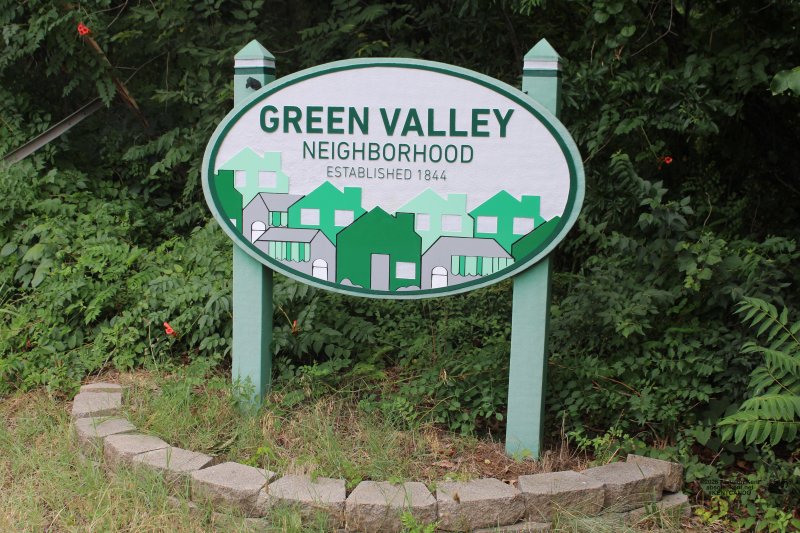
Green Valley (formerly Nauck)

Green Valley (formerly Nauck)

ARLINGTON, Va. — A visit to Green Valley reveals one of Arlington's oldest and most significant African American communities, with a history that stretches back to 1844. That year, Levi Jones became the first African American to own land in the area when he purchased 14 acres near Green Valley Manor. Jones's parents had been enslaved by George Washington and were later freed under the terms of Martha Washington's estate.

Following the Civil War, formerly enslaved families established a thriving community, building homes, churches, businesses, and civic institutions despite the barriers imposed by segregation. Green Valley became home to landmarks including Macedonia Baptist Church, Mount Zion Baptist Church, Green Valley Pharmacy, Friendly Taxi Cab Company, and Green Valley Ball Park. The neighborhood was also home to Dr. Charles Drew, whose pioneering blood-plasma research revolutionized modern medicine.

Although the community came to be known as "Nauck" after a white developer subdivided the area in the 1870s, residents continued to refer to their neighborhood as Green Valley. After decades of community advocacy, Arlington officially restored the historic name in 2019, recognizing the identity that generations of residents had preserved.

Today, Green Valley stands as a testament to resilience, self-determination, and the enduring legacy of the families who built one of Arlington County's most historic communities.

📸: https://absolonkent.net/photogallery/index.php?/category/721


We Make History: Anacostia Community Museum

We Make History: Anacostia Community Museum
WASHINGTON — The Anacostia Community Museum, one of the Smithsonian museums dedicated to exploring the rich history, culture, and experiences of local communities, was a new opportunity to learn, reflect, and appreciate the stories that shape our shared history.
 
The museum recently reopened with several new exhibitions; each offering visitors a unique perspective. On the Record explores how communities preserve their histories through photographs, oral histories, newspapers, music, and personal archives, demonstrating that history is often recorded by those who live it. Portals to the Past invites visitors to discover connections between the past and present through objects, places, and personal stories that reveal the enduring impact of history on our daily lives. Game Changers and Scorekeepers celebrates the individuals, organizations, and communities that have transformed sports, highlighting how athletics can inspire social change, strengthen communities, and create opportunities for future generations. District of Creativity showcases the remarkable artistic talent, innovation, and cultural expression found throughout Washington, D.C., celebrating the people and neighborhoods that make the nation's capital such a vibrant creative community. Together We Make History reminds us that history is created every day through the actions of ordinary people. By sharing our stories, preserving our experiences, and supporting our communities, we all contribute to the historical record.
 
Each exhibition encourages visitors to see history not as something confined to the past, but as something we continue to create together every day.


Carter Family Cemetery

Carter Family Cemetery

VIENNA, Va. — Hidden among the neighborhoods of Tysons, the Carter Family Burial Plot is the last surviving physical reminder of the Carter family and the once-thriving Freedom Hill community.

In 1842, Keziah Carter, a woman of Tauxenent/Pamunkey ancestry, purchased 50 acres of land here after securing the freedom of her enslaved husband, Robert Carter. At a time when Black and mixed-race families faced extraordinary legal and social barriers to land ownership, the Carters established a home and farm that became the heart of Cartersville, one of Fairfax County's earliest free Black communities.

Their descendants left a lasting legacy. During the Civil War, Lucy Carter carried manumission papers to prove her free status and was granted special Union travel passes in 1864. Historians believe she may have served as a Union informant, helping support the Union cause during one of the nation's most turbulent periods.

Today, the Carter Family Burial Plot at 1737 Key West Lane, Vienna preserves the resting place of this pioneering family. Although only one headstone—Millie Carter Whales—remains visible, historical records indicate that several members of the Carter family are buried here. Preservation efforts continue to ensure that their story is not forgotten.

📸: absolonkent.net/photogallery/index.php?/category/716


Freedom Hill — Cartersville, the Freedom Hill Redoubt & Freedom Hill Park

Freedom Hill — Cartersville, the Freedom Hill Redoubt & Freedom Hill Park

VIENNA, Va. — Freedom Hill was one of Fairfax County's earliest free Black communities, where generations of free African American and mixed-race families built homes, farmed the land, and shaped their own future long before the Civil War.

Located near what is now Tysons, Freedom Hill earned its name from the unusually large number of free Black residents who called these hills home. Families such as the Carters and Dobsons established a thriving community through perseverance, manumission, self-purchase, and birth into freedom. Their proximity to Washington, D.C., provided opportunities and connections that helped sustain this extraordinary settlement.

During the Civil War, Freedom Hill's residents strongly supported the Union. In 1864–1865, Union soldiers constructed Redoubt Freedom Hill, a small fort overlooking Chain Bridge Road to help defend the approaches to Washington. Though the fort never saw major combat, its name permanently recognized the community's identity and legacy. Among the community's notable residents was Lucy Carter, a free woman of color who carried her manumission papers at all times and is believed by some historians to have served as a Union informant.

Today, visitors can explore Freedom Hill Fort Park (8531 Old Courthouse Road), where the original earthworks remain alongside interpretive exhibits installed in 2021 as part of Fairfax County's Untold Stories program. The exhibits honor the Carter, Dobson, and other Freedom Hill families while recognizing the community's Tauxenent heritage.

📸: absolonkent.net/photogallery/index.php?/category/716