Macedonia Baptist Church & Historical Marker

Macedonia Baptist Church & Historical Marker

ARLINGTON, Va. โ€” Macedonia Baptist Church traces its origins to 1908, when residents of Arlington's Green Valley community gathered for prayer meetings in the home of Bonder and Amanda Johnson. From those modest beginnings, the congregation grew into the first African American church established by the Nauck (now Green Valley) community itself.

After constructing an early chapel beside the Johnson home, the congregation acquired Peyton Hall near Nauck Station before formally organizing as Macedonia Baptist Church in 1911. Under its first pastor, the Rev. John Gilliam, the church quickly became a center of worship and community life, with its first baptisms taking place in Four Mile Run in 1912.

As Green Valley expanded, so did the church. A new sanctuary was completed in 1927, and the cornerstone for the present church was laid in 1971. During the pastorate of Dr. Leonard L. Hamlin Sr., Macedonia broadened its mission beyond the pulpit, establishing the Bonder and Amanda Johnson Community Development Corporation in 1999, developing affordable housing through The Macedonian, and expanding community services with a family life center.

On November 29, 2003, Arlington County dedicated a historical marker recognizing Macedonia Baptist Church's enduring contributions to Green Valley. More than a century after its founding, the congregation continues to serve as both a spiritual home and a cornerstone of one of Arlington's oldest African American communities.

๐Ÿ“ธ: absolonkent.net/photogallery/index.php?/category/730


Mount Zion Baptist Church

Mount Zion Baptist Church

ARLINGTON, Va. โ€” Founded in 1866 by formerly enslaved residents of Freedman's Village, the congregation of Mount Zion Baptist Church began as the Old Bell Churchon the former Arlington estate of Robert E. Lee. As the federal government closed Freedman's Village in the 1880s, the church relocated to what would become Arlington County, carrying with it the original church bell that inspired its first name.
The congregation was displaced a second time in 1942 when its sanctuary was condemned to make way for the road network serving the newly constructed Pentagon. Undeterred, church members purchased land in Green Valley, where they dedicated their present sanctuary in 1945. The building was designed by Romulus C. Archer Jr., one of the first licensed African American architects in Washington, D.C.

Community historians credit Mount Zion, together with Mount Olive Baptist Church, with helping establish two of Arlington's historic Black neighborhoods following the closure of Freedman's Village. Mount Zion's members settled in Green Valley, where the church has remained a spiritual and community anchor for generations.

An Arlington County historical marker at the corner of South Kenmore and South 19th Streets commemorates Mount Zion Baptist Church's remarkable journey and recognizes its distinction as the oldest African American congregation in Arlington County.

Today, more than 160 years after its founding, Mount Zion Baptist Church continues to serve the Green Valley community while preserving an extraordinary chapter of Arlington's history. A visit offers a powerful connection to the origins of Arlington's oldest African American congregation and the enduring legacy of the families who established the Green Valley community.

๐Ÿ“ธ: absolonkent.net/photogallery/index.php?/category/731


Green Valley (formerly Nauck)

Green Valley (formerly Nauck)

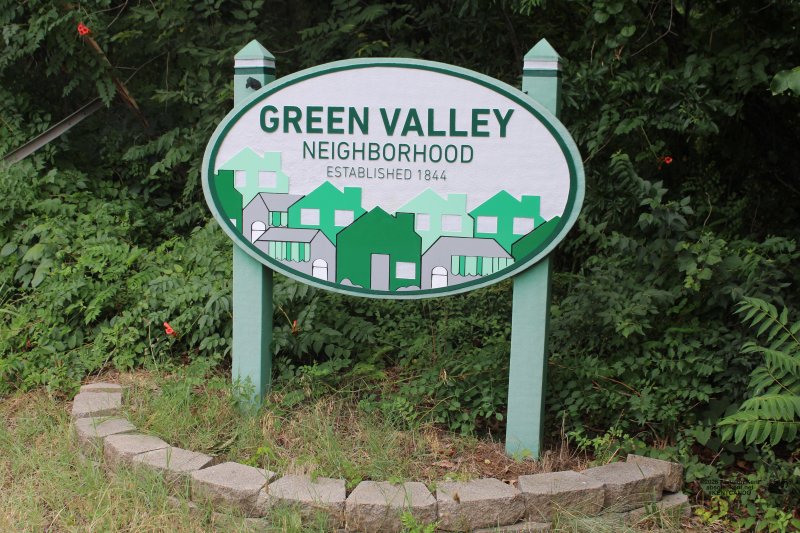
ARLINGTON, Va. โ€” A visit to Green Valley reveals one of Arlington's oldest and most significant African American communities, with a history that stretches back to 1844. That year, Levi Jones became the first African American to own land in the area when he purchased 14 acres near Green Valley Manor. Jones's parents had been enslaved by George Washington and were later freed under the terms of Martha Washington's estate.

Following the Civil War, formerly enslaved families established a thriving community, building homes, churches, businesses, and civic institutions despite the barriers imposed by segregation. Green Valley became home to landmarks including Macedonia Baptist Church, Mount Zion Baptist Church, Green Valley Pharmacy, Friendly Taxi Cab Company, and Green Valley Ball Park. The neighborhood was also home to Dr. Charles Drew, whose pioneering blood-plasma research revolutionized modern medicine.

Although the community came to be known as "Nauck" after a white developer subdivided the area in the 1870s, residents continued to refer to their neighborhood as Green Valley. After decades of community advocacy, Arlington officially restored the historic name in 2019, recognizing the identity that generations of residents had preserved.

Today, Green Valley stands as a testament to resilience, self-determination, and the enduring legacy of the families who built one of Arlington County's most historic communities.

๐Ÿ“ธ: https://absolonkent.net/photogallery/index.php?/category/721


Mt. Calvary Baptist Church — Oldest Black Church in Fairfax City

Mt. Calvary Baptist Church — Oldest Black Church in Fairfax City

FAIRFAX CITY, Va. โ€” Founded onย May 15, 1870, Mt. Calvary Baptist Church stands as one of Fairfax County's most enduring symbols of faith, resilience, and community.

Established by formerly enslaved men and women who settled near the Fairfax County Courthouse after the Civil War, their very first act of freedom was not to build homes for themselvesโ€”but to build a house of worship. That powerful commitment became the foundation of a congregation that has faithfully served the community for more than 155 years and during the era of segregation and Jim Crow, Mt. Calvary was much more than a church. It became a vital center for Black civic leadership and the fight for civil rights in Fairfax County.

Originally located near today's Route 123, the congregation moved to its present home on Chain Bridge Road in 1957. A Virginia historical marker nearby commemorates the church's early baptismal site on Accotink Creek, where members were baptized through the 1930s.

๐Ÿ“ธ: absolonkent.net/photogallery/index.php?/category/714


Luther P. Jackson High School Site

Luther P. Jackson High School Site

FALLS CHURCH, Va. โ€” Before 1954, African American students in Fairfax County who wanted to attend high school had to travel outside the countyโ€”either to Manassas or to schools in Washington, D.C. That changed when Luther P. Jackson High School opened in September 1954 as the county's firstโ€”and onlyโ€”high school built to serve African-American students. Named for historian, educator, and voting-rights advocate Luther Porter Jackson, the school became a source of pride and opportunity for generations of students.

Ironically, the school opened the same year the U.S. Supreme Court issued its landmark Brown v. Board of Education decision declaring segregated public schools unconstitutional. Despite the ruling, Luther Jackson opened as a segregated school and remained the county's only school for Black students in grades 7โ€“12 until integration began in 1965.

Today, the building continues to serve the community as Luther Jackson Middle School, while a Fairfax County historical marker commemorates the school's important role in the county's educational and civil rights history.

๐Ÿ“ธ: absolonkent.net/photogallery/index.php?/category/708