African Burial Ground National Monument

African Burial Ground National Monument


NEW YORK — The African Burial Ground National Monument in New York City is a sacred and profoundly important site that preserves one of the oldest and largest known excavated burial grounds in North America for people of African descent.

The burial ground dates back to the 17th century, when New York was still known as New Amsterdam and slavery was an established part of the colony's economy and society. Between the 1630s and 1795, an estimated 15,000 Africans and African Americans were buried in this sacred ground, including enslaved and free people. For generations, this community lived, worked, raised families, worshiped, and contributed to the growth of New York City, even as they endured the harsh realities of slavery, discrimination, and inequality.

The burial ground was largely forgotten and eventually built over as Manhattan expanded. It was rediscovered in 1991 during construction of a federal office building at 290 Broadway. Archaeological excavations revealed the remains of more than 400 individuals, including men, women, and children. The discovery became a landmark moment in the recognition and preservation of African American history in New York and throughout the United States.

In 2006, the site was designated the African Burial Ground National Monument, ensuring that the stories of those buried there would be remembered and honored. The memorial stands as a powerful tribute to their humanity, resilience, and enduring legacy—and as a reminder that the history of America cannot be fully told without acknowledging the contributions and experiences of African people and their descendants.

Visiting this sacred ground was deeply personal and emotional for me. It was a humbling reminder of the importance of honoring those who came before us and making sure their stories are never forgotten. I left with a deeper sense of gratitude, reflection, and responsibility to remember, teach, and tell their stories to the generations yet to come.

📸: absolonkent.net/photogallery/index.php?/category/741


Agnewville / The Chinn Family Historical Marker

Agnewville / The Chinn Family Historical Marker

WOODBRIDGE, Va. — Hidden in the heart of today's Lake Ridge community is the remarkable story of Agnewville—also known as Chinntown and Smoketown—a thriving African American community built by the Chinn family after emancipation.

Beginning with Thomas and Mary Jane Chinn and their eight sons, the family purchased nearly 500 acres, creating a vibrant community with homes, a post office, general store, restaurant, gaming hall, and Mount Olive Baptist Church, where generations of the Chinn family are still laid to rest.

Although Agnewville gradually disappeared as transportation routes changed and the area was redeveloped, its legacy lives on through the Prince William County Historical Commission marker that honors the resilience, entrepreneurship, and vision of a family who transformed freedom into opportunity for generations.

Every historical marker tells a story—and this one reminds us that communities can disappear from the landscape but never from history.

📸: absolonkent.net/photogallery/index.php?/category/739


Lomax AME Zion Church, Cemetery & Historical Marker

Lomax AME Zion Church, Cemetery & Historical Marker

ARLINGTON, Va. — Lomax AME Zion Church preserves one of the most significant chapters in Arlington County's African American history. Founded by formerly enslaved residents of Freedman's Village, the congregation traces its origins to 1863, making it the oldest extant African American church in Arlington County.

The congregation began as Wesley Zion Church, later known as Little Zion Church, within Freedman's Village on the former Arlington estate of Robert E. Lee. As the federal government prepared to close the settlement, members temporarily worshipped in the home of Levi and Sarah Ann Jones before purchasing a one-acre site in Green Valley in 1874, where the church has remained for more than 150 years. The congregation later adopted the name Lomax AME Zion Church in honor of Bishop T.H. Lomax, an influential leader of the AME Zion Church.

The present Gothic Revival sanctuary, completed after construction began in 1922*, is recognized as an Arlington County Landmark and is listed on the Virginia Landmarks Register as the county's oldest surviving African American church building. Its adjoining cemetery preserves the stories of generations of Green Valley residents, including formerly enslaved men and women whose lives helped shape the community.

Lomax AME Zion Church also played an important role in the modern Civil Rights Movement. In August 1963, under the leadership of the Rev. Arthur W. Walls, the congregation welcomed activists traveling to the March on Washington. On the eve of the historic march, Martin Luther King Jr and Ralph Abernathy addressed supporters in the church parking lot before traveling to the nation's capital, where Dr. King delivered his iconic "I Have a Dream" speech the following day.

Today, Lomax AME Zion Church continues to stand as both a place of worship and a lasting symbol of Green Valley's resilience, preserving a legacy that spans from emancipation through the Civil Rights Movement and into the present day.

📸: absolonkent.net/photogallery/index.php?/category/729


Mount Zion Baptist Church

Mount Zion Baptist Church

ARLINGTON, Va. — Founded in 1866 by formerly enslaved residents of Freedman's Village, the congregation of Mount Zion Baptist Church began as the Old Bell Churchon the former Arlington estate of Robert E. Lee. As the federal government closed Freedman's Village in the 1880s, the church relocated to what would become Arlington County, carrying with it the original church bell that inspired its first name.
The congregation was displaced a second time in 1942 when its sanctuary was condemned to make way for the road network serving the newly constructed Pentagon. Undeterred, church members purchased land in Green Valley, where they dedicated their present sanctuary in 1945. The building was designed by Romulus C. Archer Jr., one of the first licensed African American architects in Washington, D.C.

Community historians credit Mount Zion, together with Mount Olive Baptist Church, with helping establish two of Arlington's historic Black neighborhoods following the closure of Freedman's Village. Mount Zion's members settled in Green Valley, where the church has remained a spiritual and community anchor for generations.

An Arlington County historical marker at the corner of South Kenmore and South 19th Streets commemorates Mount Zion Baptist Church's remarkable journey and recognizes its distinction as the oldest African American congregation in Arlington County.

Today, more than 160 years after its founding, Mount Zion Baptist Church continues to serve the Green Valley community while preserving an extraordinary chapter of Arlington's history. A visit offers a powerful connection to the origins of Arlington's oldest African American congregation and the enduring legacy of the families who established the Green Valley community.

📸: absolonkent.net/photogallery/index.php?/category/731


Green Valley (formerly Nauck)

Green Valley (formerly Nauck)

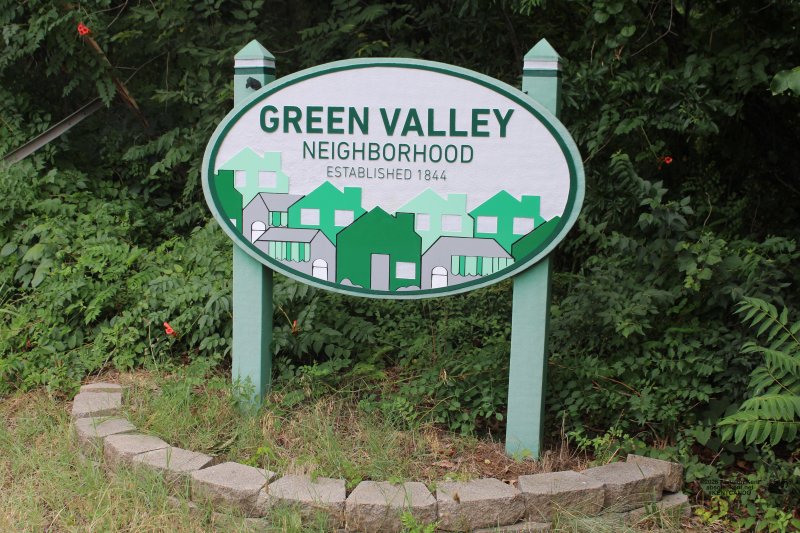
ARLINGTON, Va. — A visit to Green Valley reveals one of Arlington's oldest and most significant African American communities, with a history that stretches back to 1844. That year, Levi Jones became the first African American to own land in the area when he purchased 14 acres near Green Valley Manor. Jones's parents had been enslaved by George Washington and were later freed under the terms of Martha Washington's estate.

Following the Civil War, formerly enslaved families established a thriving community, building homes, churches, businesses, and civic institutions despite the barriers imposed by segregation. Green Valley became home to landmarks including Macedonia Baptist Church, Mount Zion Baptist Church, Green Valley Pharmacy, Friendly Taxi Cab Company, and Green Valley Ball Park. The neighborhood was also home to Dr. Charles Drew, whose pioneering blood-plasma research revolutionized modern medicine.

Although the community came to be known as "Nauck" after a white developer subdivided the area in the 1870s, residents continued to refer to their neighborhood as Green Valley. After decades of community advocacy, Arlington officially restored the historic name in 2019, recognizing the identity that generations of residents had preserved.

Today, Green Valley stands as a testament to resilience, self-determination, and the enduring legacy of the families who built one of Arlington County's most historic communities.

📸: https://absolonkent.net/photogallery/index.php?/category/721